What's new in dementia?
Science Victoria Edition







HELEN MACPHERSON
Institute for Physical Activity and Nutrition, Deakin University
There are close to 450,000 people living with dementia in Australia and, on current trends, this is expected to exceed 1 million within 40 years. But the condition has a much wider reach. An estimated 1.7 million Australians already are involved in the care of people living with dementia.
But what if the future of dementia looks different from the past? New work suggests it can. Recently, there have been findings which have helped scientists to understand more about the causes of dementia and to develop innovative tools to aid clinicians in diagnosis and treatment.
Dementia is not a single disease
The most common form of dementia is Alzheimer’s disease, a disorder in which nerve cells in the brain begin to degenerate. Toxic proteins, beta-amyloid and tau, accumulate and progressively lead to the death of the cells. Another form of dementia, vascular dementia, is caused by reduced blood supply to the brain and can occur after a stroke. Many people with dementia will have a combination of both types of damage in their brain.
Other causes of dementia include Lewy Body Disease and Alcohol-Related Brain Damage. Chronic Traumatic Encephalopathy (known as CTE) occurs in response to head injury. This form of dementia is an emerging area of concern for people who play contact or collision sports, such as the various forms of football, where there is a risk of repeated impacts to the head over time. Professional sporting clubs are now taking concussion seriously.
In Australia, the predicted rise in dementia is driven by the ageing of the country’s population. The risk of developing dementia increases with age - up to 30% for a person 85 years or older. Women are more likely than men to live beyond this age, and to develop dementia. Over the next 40 years the number of people aged above 85 is expected to increase almost three-fold. This shifting demographic is the main driver of the growing number of people living with dementia.
Although dementia is commonly thought of as a disease affecting older people, about 7% of all people living with dementia have younger onset dementia which affects people under the age of 65.
It is less well known that children can also develop dementia. Childhood dementia can be caused by more than 100 rare genetic disorders. Similar to other forms of dementia, this condition leads to progressive decline and is terminal. More research is urgently needed to help understand it.
Prevention is better than cure
While the number of people expected to be living with dementia in the future sounds daunting, it is not set in stone. Although at present there is no cure for dementia, there are steps that can reduce the possibility of dementia, and which can be taken by individuals and at a population level though public health initiatives.
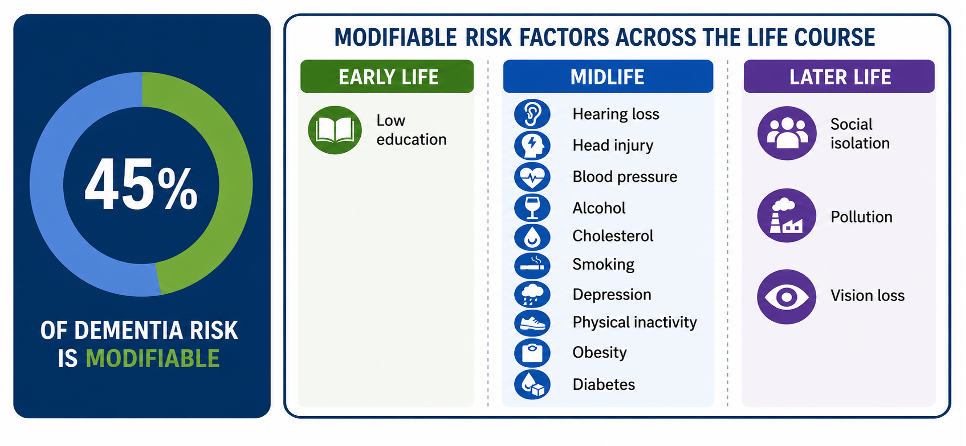
Although age is the main risk factor for dementia, researchers have identified that about 45% of dementia risk is due to addressable health conditions, behaviours or environmental influences.
In early life, for instance, a low level of education increases the chances of dementia. In midlife, risk factors include untreated hearing impairment, traumatic brain injury, high blood pressure, high cholesterol, excessive alcohol intake, obesity, smoking, depression and physical inactivity. Later in life, social isolation, air pollution and untreated visual loss increase the risk of dementia.
And paying attention to other behaviours can further reduce the chance of dementia. These include diet. A diet rich in healthy fats, vegetables and fruit, and low in highly processed foods can directly benefit brain health, while helping to cope with other health conditions such as obesity, high blood pressure, high cholesterol and diabetes. Getting enough sleep is another important consideration as the brain clears toxic waste during sleep, including the beta amyloid proteins that build up in Alzheimer’s disease.
A new era for dementia treatment
Until recently, drug treatments for Alzheimer’s disease were only suitable for symptoms of the disease, such as memory loss, and had no direct impact on dementia progression.
This is beginning to change. In Australia two new disease modifying therapies were approved last year. Both are designed to target the cause of Alzheimer’s disease, the accumulation of beta amyloid in the brain. Lecanemab (Leqembi) is taken long term to reduce the build-up of toxic deposits or plaques, whilst Donanemab (Kisunla) breaks down existing plaques. Taking the latter can be stopped once plaque levels drop. Both come with the risk of other brain side effects such as bleeding or swelling. While these medicines represent a substantial advance, they are suitable only for people in the early stages of dementia.
We are in an exciting era of a new generation of drugs advancing from clinical trials to patient treatment. Compared to a decade ago, when several high-profile trial failures led to a cutback in Alzheimer’s disease research, there has been a 35% increase in drugs developed for dementia. New clinical trials are also targeting tau and problems with the immune system and inflammation in the brain. Several of these trials of disease modifying medicines will be completed this year, and may yield promising new avenues of treatment .
Earlier detection leads to more treatment options
A big challenge is identifying dementia early, so treatment or interventions can be most effective. This is especially important for medicines that can only be started in the early stages of dementia or cognitive decline.
Blood biomarkers are providing new hope, crossing over from research laboratories to clinical practice. The first new blood test to assist in Alzheimer’s disease diagnosis in Australia was approved last year. These tests can reduce the need for expensive PET scans when diagnosing Alzheimer’s disease, but they do not replace testing for other causes of dementia. In fact, in this case blood tests are unlikely to replace existing dementia diagnosis procedures, but in future they will help identify which treatment is most suitable for different individuals.
There are further limits to blood tests in clinical practice at this stage. They are not suitable for widespread screening, that is to detect Alzheimer's disease or other causes of dementia in large groups of younger people without clinical symptoms.
Apps and online tools may help people to access diagnosis earlier. Dementia Australia’s free BrainTrack app (which I am helping to develop) allows people to monitor cognition over time and share results with their general practitioner.
Following diagnosis, treatment known as reablement focuses on helping individuals to maintain or improve their independence. Receiving a diagnosis early makes reablement more effective, because it supports people to manage everyday tasks, and experience better quality of life.
Towards a more hopeful future for dementia
In an ageing society, we cannot ignore the reality of dementia. Prevention remains our most powerful tool and can be thought of as a lifelong process. When combined with advances in early detection and treatment, we can move towards a better outlook for people living with dementia.
Want to stay up to date and get articles like this and the latest Science Victoria digital magazine delivered straight to your inbox?
Subscribe for free now at subscribe.rsv.org.au
REFERENCES
1. Banner image: Robina Weermeijer, Unsplash
Other articles of interest








Discover how you can join the society
Join The Royal Society of Victoria. From expert panels to unique events, we're your go-to for scientific engagement. Let's create something amazing.