Farming the transition: How renewable energy is reshaping Victorian agriculture
Science Victoria Edition
.jpg)




Farmer and member of the Board of Directors, Renewable Energy Alliance
Across the landscape of regional Victorian, a transformation is underway. Wind turbines are rising above paddocks, solar arrays are blooming across plains, and new transmission lines are tracing paths through long-held farming districts, complementing the 6500 km of existing infrastructure critical to powering Victoria’s homes and industry.
The State’s transition to renewable energy is accelerating rapidly, and those of us whose livelihoods and lifestyles depend on agriculture sit at its centre. In a state where agriculture covers more than half the landmass, the intersection between farming and energy has become one of the defining challenges, and opportunities, of this transition.
Victoria has committed to generating 95% of its electricity from renewable sources by 2035. Although wind farms are already contributing more than 20% of electricity generation, achieving that target will require not just new technology, but new ways of using our existing land.
Where energy meets agriculture
The transition is well underway across Australia. More than 4.2 million of 11 million households nationally now have solar panels, making a huge impact on our electricity grid. It is not widely recognised that this installation of domestic solar systems in cities and country areas already helps meet electricity demand during the crucial early evening period when children get home from school and families cook dinner and watch TV.
But the geography of renewable energy means that much of the infrastructure has to be located in regional areas. In Victoria, wind resources are strongest in the southwest and along the coast, while large-scale solar developments demand flat, open land, often the same land used for grazing and cropping. This is evidenced by the construction of the recent SEC Renewable Energy Park in Horsham. Sited on former cropping land, near to existing transmission lines and the Horsham Terminal Station, the location of the new solar farm alleviated the necessity for new transmission lines.
So the development of Renewable Energy Zones is concentrating projects in specific parts of the state, many of which are highly productive agricultural regions. This has placed farmers at the forefront of the energy transition, sometimes as participants, sometimes as neighbours, and often as both.
Farming among the turbines
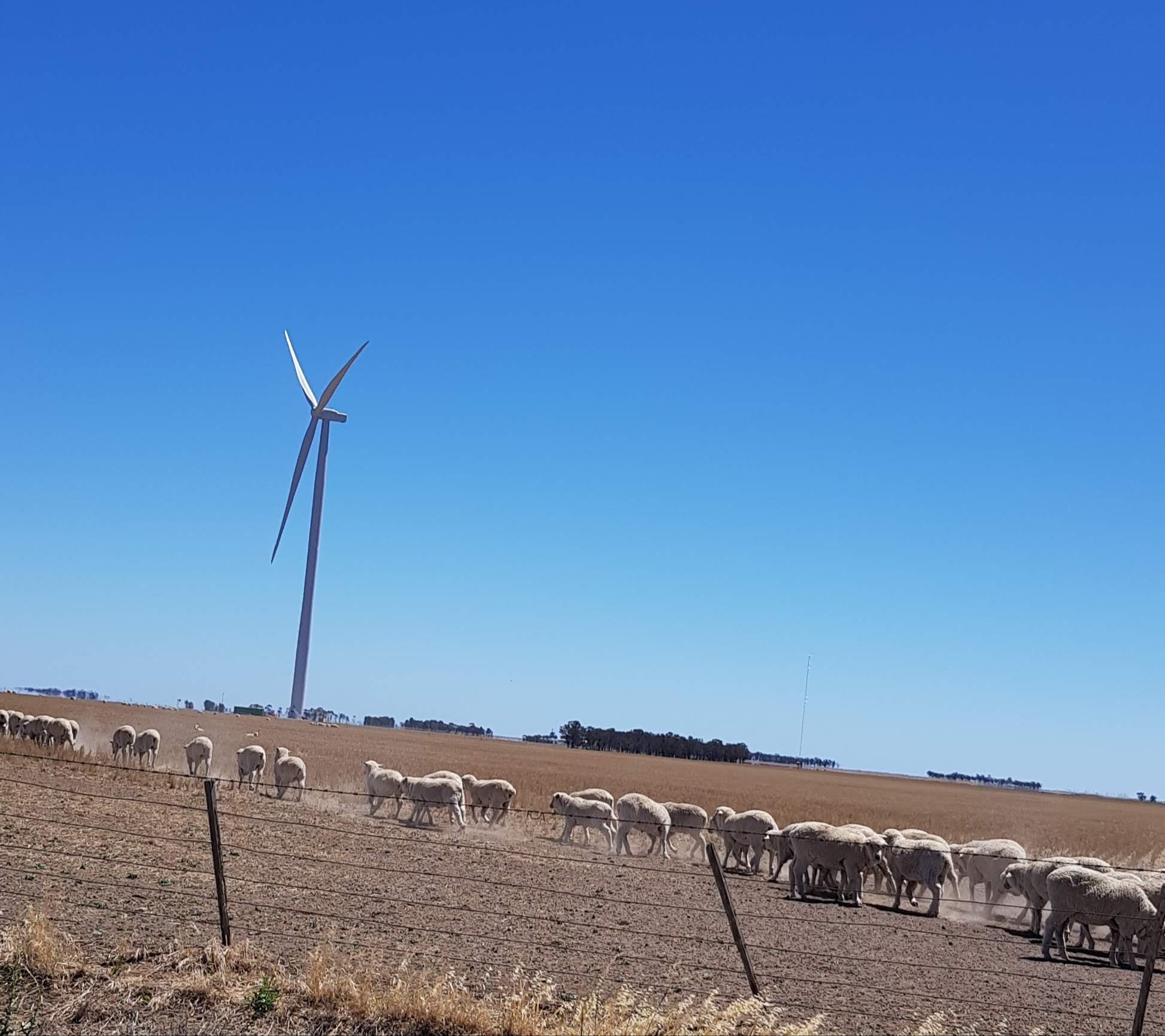
Luckily, one of the defining features of wind energy is a light footprint. Turbines and associated infrastructure occupy only a small portion – about 1.5% – of the land on which they are built, allowing most agricultural activities to continue largely unchanged. Sheep and cattle can graze beneath turbines, cropping continues between access tracks, and farm operations adapt around the infrastructure in a similar fashion to working around trees, roads or sheds.
This ‘co-existence’ model has become central to how the renewable transition is framed in rural areas. Rather than replacing agriculture, wind energy is layered onto it and, for farmers, this has proven to be a profitable, practical and workable arrangement.
Solar energy, however, presents a different challenge. Large-scale solar farms can cover extensive areas, potentially displacing agricultural production. Even so, emerging approaches such as agrivoltaics, where solar panels are combined with grazing or cropping, are beginning to demonstrate that dual land use is possible.
At sites such as the Numurkah Solar Farm in northern Victoria, sheep graze among the panels, maintaining agricultural output while supporting energy generation. In fact, farmers have even reported an uplift in wool quality and sheep welfare. The sheep keep the grass low, thus saving on slashing costs, moisture run-off from the panels leads to more grass for grazing and the panels themselves protect the sheep from the weather as they feed beneath.
A new kind of farm income
For landholders who host renewable infrastructure, the transition can bring a significant economic shift. Lease payments for wind turbines or transmission easements can provide a stable, long-term income stream that is largely insulated from seasonal variability, commodity prices, and climate risk.
In an industry defined by uncertainty, this income can act as a form of financial stabilisation. Some farmers describe it as a ‘drought-proof’ revenue source, one that allows them to invest in their operations, manage debt, or simply ride out difficult seasons.
But these benefits are often not evenly distributed. While host landholders receive direct payments, neighbouring properties may experience visual or operational impacts without the same financial return. Although now routinely addressed by means of neighbour payments and allowances for community funds and grants, this unevenness can contribute to tensions within rural communities.
Community tensions and social licence
The rapid expansion of renewable energy has not been without controversy. In some regions, proposals for wind farms, solar arrays, and transmission lines have sparked strong opposition. Concerns range from the loss of productive farmland to the industrialisation of rural landscapes. And then there’s the scale and pace of development.
For many farmers, the issue is not the advent of renewable energy itself, but how it is implemented. Questions of consultation, fairness, and local control are central. Who decides where infrastructure is built? How are communities engaged? And who ultimately benefits?
These questions highlight the importance of ‘social licence’, or the level of acceptance or approval by local communities. Without it, new projects can face delays, legal challenges, or outright rejection. As a result, developers and governments are increasingly recognising that successful projects depend as much on relationships within communities as on engineering.
Organisations such as the Renewable Energy Alliance (RE-Alliance) are working to address social licence issues for renewables by advocating for meaningful benefits for regional communities through government policy. RE-Alliance aims to coordinate the needs of local communities with those of industry to deliver positive social outcomes.

Energy as a farm tool
In addition to large-scale infrastructure, the energy transition is also reshaping agriculture at the farm level. Increasingly, farmers are investing in their own renewable energy systems to address rising energy costs. They are installing solar panels, batteries, and electrified equipment to reduce costs and improve efficiency.
Programs such as Victoria’s Agriculture Energy Investment Plan have supported this shift, helping farmers to adopt technologies that lower energy bills and reduce emissions. In sectors where energy use is significant, such as dairy, irrigation, and horticulture, these changes can have a meaningful impact on profitability.
So, the energy transition is not just something happening to agriculture, but something being adopted within it.
The hidden footprint: transmission
While wind turbines and solar panels are the most visible symbols of the transition, the infrastructure that connects them to the grid may have a broader impact on agricultural land.
New transmission lines are required to move renewable energy from regional areas to population centres. In Victoria, energy has historically been generated by coal-fired power plants in Gippsland, with transmission lines feeding power from there to Melbourne and beyond. Renewable energy is now generated across the State, requiring modifications to the transmission system to create a better and more reliable flow of power across Victoria and beyond, to New South Wales and South Australia.
This nationalisation of the grid will also enhance Australia’s energy security by moving power between states when and to where it is most needed. These wires, however, can cross multiple properties, potentially fragmenting land and introducing new constraints on farming operations. For some landholders, the impact of transmission infrastructure is more significant than the generation assets themselves.
This has brought increased attention to planning processes and compensation frameworks, as well as the need for careful route selection and community engagement.
Environmental trade-offs
The expansion of renewable energy brings clear environmental benefits, particularly in reducing greenhouse gas emissions. Wind energy alone avoids significant emissions compared to fossil fuel generation, contributing to broader climate goals that are critical for the long-term sustainability of agriculture, an industry highly impacted by climate volatility.
Renewable projects also introduce local environmental considerations, overseen in Victoria by an Environmental Effects Statement during the planning phase. This assesses impacts on biodiversity, cultural heritage and native vegetation which need to be monitored and managed throughout the construction and operation of the project. Balancing global environmental benefits with local ecological impacts remains an ongoing challenge.
Regional economies in transition
The development of renewable energy is also reshaping regional economies. Construction phases bring jobs, investment, and increased activity to local areas. The Murra Warra Wind Farm in Western Victoria injected more than $80 million dollars of additional revenue directly into the regional community throughout its four-year construction period. Over the longer term, operational roles and maintenance provide ongoing employment, though at a smaller scale.
More broadly, the transition is creating new economic pathways in regional Victoria, positioning some areas as energy hubs alongside their traditional agricultural roles.
The future
As the pace of energy transition accelerates, the relationship between agriculture and renewable energy will continue to evolve. Emerging models such as agrivoltaics, farmer-led energy projects, and more collaborative planning approaches suggest that integration is possible, but achieving it will require careful balancing of economic, environmental, and social factors.
What is clear is that the transition is not just changing how Victoria generates electricity. It is reshaping the function and value of rural land itself. Farms are no longer solely for food and fibre production, they are becoming part of the State’s energy system.
For agriculture, this presents both opportunities and challenges. The energy transition is not just changing how Victoria is powered, it is quietly reshaping the purpose, economics and identity of its regional communities and the farmland that is their lifeblood.
Want to stay up to date and get articles like this and the latest Science Victoria digital magazine delivered straight to your inbox?
Subscribe for free now at subscribe.rsv.org.au
Other articles of interest






Discover how you can join the society
Join The Royal Society of Victoria. From expert panels to unique events, we're your go-to for scientific engagement. Let's create something amazing.