Future Threads: Sustainable fashion in a changing climate
Science Victoria Edition


Strategic Communications, The University of Melbourne
The textile industry is one of the world’s largest polluters, responsible for about four billion tonnes of CO2 emissions a year.
In September, as part of its annual Innovation Week, Melbourne Connect (The University of Melbourne’s innovation hub) held a panel session where three alumnae now working in the textiles industry shared how businesses and individuals can help transform it for the better.
Textile Industry Panel
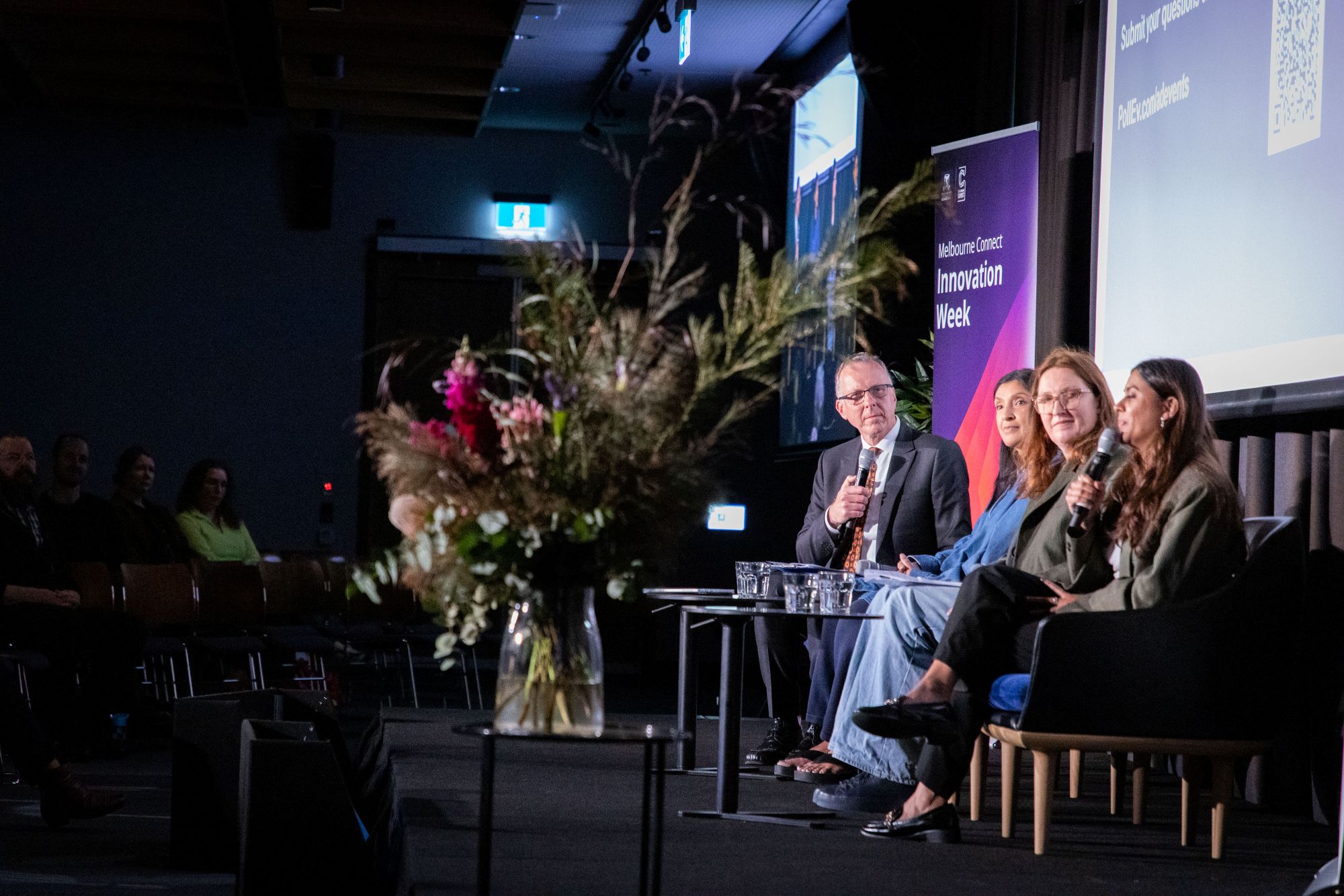
Facilitator: Professor Damien Giurco, the Chair of Circular Economy in the Faculty of Engineering and Information Technology. His research interests include supporting sustainable consumption and production, through resource stewardship and circular business models.
Vinita Baravkar, founder of Bhumi Organic Cotton – Having embarked on a career in maternal and child health with a Master of International Public Health, Vinita became inspired to move into textiles after working in an agricultural zone of India. Her career path took her into communities where she witnessed the human and environmental cost of conventional cotton production – from pesticide exposure and polluted waterways to child labour, farmer hardship and preventable health impacts.
Erika Martin, Head of Sustainability at Country Road Group – Erika studied science before moving onto a Master of Enterprise degree. Now, she applies her unique skill set to overseeing Country Road’s sustainability strategy. As a sustainability professional with more than 10 years in fashion and beauty, Erika is passionate about working with organisations and their supply chains to embed responsible and circular practices.
Yesha Patel, founder of After, a doorstep textile recovery and recycling service – Yesha completed a Master of Entrepreneurship at The University of Melbourne. Since its launch in 2021, After has grown into a multi-faceted operation across Melbourne, Sydney and Auckland. To date, it has diverted about 200,000 kg of textiles from landfill.
Overcoming today's sustainabilty challenges
Professor Giurco initially asked members of the panel about the challenges they have faced in generating change in the fashion and textile industry.
Vinita said spreading general awareness about the impact of different fabrics has been challenging.
“It’s about asking [such questions as]: What is conventional cotton?; What is organic cotton?; What is linen?; What is organic linen, and what's the difference? It’s education around what's in the fabrics that we have close to our skin all the time.”
Erika said redistributing responsibility for sustainable garment creation is important.
“Brands need to be better aligned and coordinated in their approach to working with suppliers on solving these issues. I think a lot of the responsibility for solving these problems gets pushed onto the suppliers at their cost, so I think brands need to get better at sharing that cost and responsibility collectively.”
Tomorrow's sustainability challenges
Vinita said higher certification standards are a focus, as she believes there is an industry-wide rise in green washing, the practice of organisations making misleading environmental claims.
“There are many certifications out there, but for us, the north star is the Global Organic Textile Standard (GOTS). It's the strictest platinum standard in the textile industry, and it doesn't allow for any form of toxic pesticides, chemicals, child labour.”
Erika said that at the Country Road Group, she is focused on improving product quality and durability. “From my perspective, the most sustainable garment is the one that stays in use for the longest. If the product lasts, it can be worn and loved for many years, and it can be resold and passed on.”
Yesha said that at After, she has set her sights on recycling as many household textiles as possible, more than just clothing. “If you think about textiles, they can also be bedding, linen and pillows, scraps and offcuts from manufacturers and dead, faulty stock from fashion brands that can no longer be sold. At the moment, we’ve been working with hotels that go through a lot of linen refreshes. They have a lot of linen that just normally gets dumped.”
Driving systemic change
Professor Giurco next asked participants about their views on the role of government and other industry players in systemic change.
Yesha said, “We try to work with more [local] councils who can make [After] a free service for their residents.”
Erika said that Government regulation was important, as it will drive change faster than voluntary schemes.
“Something that's central and Federal would be best. I think including eco-modulation discounts on any levies will drive change towards a more sustainable, circular design. [Eco-modulation] is where the product or packaging has been designed with more sustainable features. That could be the use of mono-material, renewable material or recycled content, for example.”
Vinita said that government should mandate transparency to do with product composition and processing.
“I'd really love to see stricter labelling laws because, on the one hand, it's not only the textile – it’s also the dyes and the chemicals that go into it.”
Conscious consumption
Professor Giurco finally asked several audience-submitted questions, including: Is it possible to produce sustainable clothes for all the people on the planet at a price that's affordable?
Vinita said long supply chains were a key contributor to exorbitant prices.
“I think a big thing is taking out the middlemen. Post-COVID, we saw the rise of e-commerce. Direct-to-consumer is a model that we pride ourselves on,” she said, speaking of Bhumi’s approach.
Erika challenged consumers to reconsider their spending decisions when it came to clothing.
“I think there is something to be said for paying a little bit more – paying for quality and buying less. You can buy secondhand, shop at op shops, buy resale, consider rental and even clothing swaps.”
Takeaways
The panelists left the audience with key takeaways for how, as individuals, they could contribute to a more sustainable fashion industry.
Vinita said, “I think the biggest thing is asking questions. That introspection of asking: What is in my product?; How was it made?; Where was it made?; What's in it?; and Who made it?”
Erika reiterated the importance of buying quality, long-lasting products.
Yesha’s said that, having dealt with enormous amounts of textile waste at After, her perspective was,
“If you do have clothing that you can't donate, consider what else you can do with it. Perhaps you could repair it yourself or repurpose it.”
[1] Banner image by Sou Jest via Unsplash
Other articles of interest






Discover how you can join the society
Join The Royal Society of Victoria. From expert panels to unique events, we're your go-to for scientific engagement. Let's create something amazing.