Here comes the Sun – and the storms,.. and the pollen
Science Victoria Edition


Master of Biotechnology, The University of Melbourne
On 21 November 2016, Ambulance Victoria sent out a distress signal about a rise in breathing problems following a change in the weather.1 It was the kind of routine message that normally gets filed and forgotten. This one, however, would be studied by disaster researchers all over the world.
Fifteen minutes – on average. That is the time that elapses between a person’s first serious symptom of asthma and cardiac arrest.2 Fifteen minutes is not enough time to find your inhaler in a drawer you have not opened in years, or to explain to a 000 operator what is happening in your chest, or - in several documented cases - to say anything at all.
Apollo Papadopoulos, 35, who was finishing up work at the time, did not have those 15 minutes to spare.2 He began struggling to breathe, and within minutes, could not speak. He was one of the 10 Victorians who died that night. Hours earlier, most of them were in good enough shape to have been mowing the lawn.
By sunrise, more than 3,.200 people had arrived at hospitals in Melbourne and Geelong, about 672% more than on a typical spring evening.3 They heralded a new age in Melbourne, often now designated as the thunderstorm asthma capital of the world. And, in the years since, researchers have made progress in understanding why that terrible evening happened and in preparing for an unprecedented time of climate change.

A grain of grass, magnified
Here is a small experiment. Take a raisin and drop it into a glass of water. Nothing dramatic happens; it sits there, swelling slowly as it takes up moisture. Now, instead of a raisin, imagine something a thousand times smaller and far less passive, a grain of ryegrass pollen. It has been plucked out of a paddock by a hot northerly wind and swept towards the city. Ordinarily, a pollen grain this size does what raisins do in water: it sits swelling in your nose and throat, until it is too large to go any further. Typically, it causes nothing worse than a sneezy afternoon.
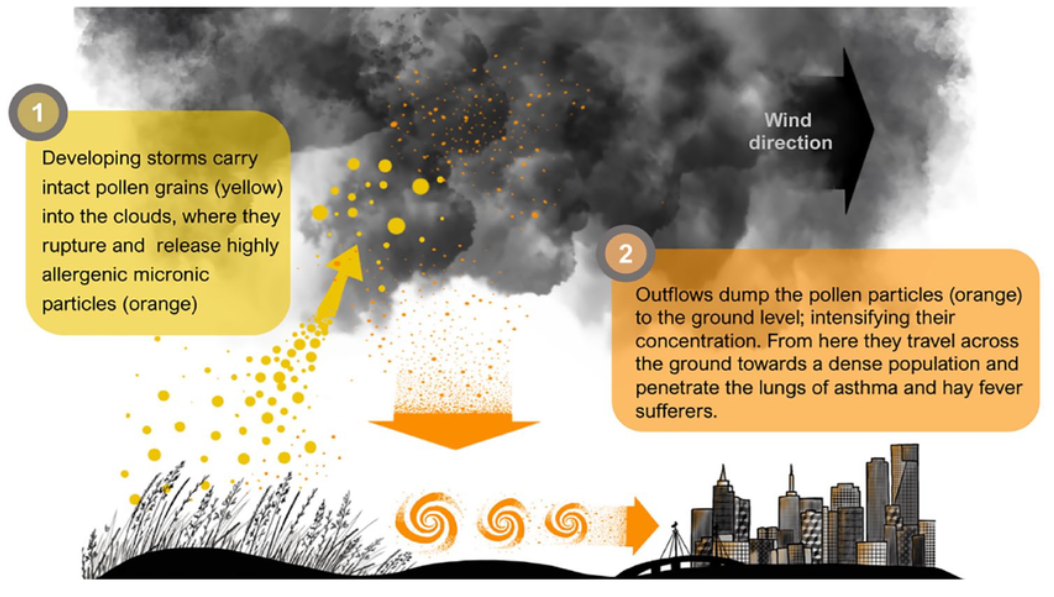
Now, introduce a very particular kind of storm. As a cool, gusty front moves through, the pollen grain finds itself inside a pocket of intense humidity. The leading hypothesis (see Figure 1) suggests that the grains swell and then rupture—bursting into hundreds of fragments so small they behave like smoke.4
As the storm’s cool, dense outflow pushes forward, it meets the warmer, more humid air already sitting near the surface, The two air masses collide along a narrow, moving boundary called a convergence line.5 These lines act as meteorological brooms, sweeping up and compacting the fine particles in the air into one dense, fast-moving band.5 The convergence lines carry those ruptured pollen fragments back down to the streets, enveloping unsuspecting people going about their daily lives.4,5 And, like smoke, the pollen fragments go exactly where they are not wanted: deep into the lungs.
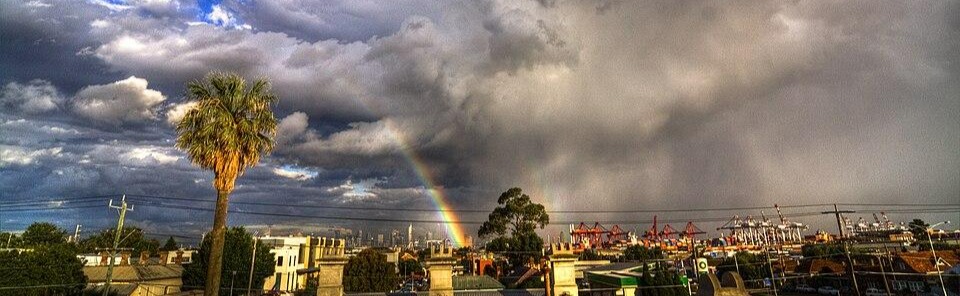
On 21 November 2016, Melbourne’s pollen count exceeded 100 grains per cubic metre, and the temperature dropped 10°C in less than an hour as the storm crossed the City.3 Nobody did anything wrong. And nobody could have seen it coming. That is the terrifying truth at the centre of epidemic thunderstorm asthma (ETSA): there is no single villain.
Keeping track of pollen: where science counts
Due to the high incidence of pollen allergies and thunderstorm asthma, Melbourne is no stranger to pollen-counting. A project, started by Marjorie Sherwood at the Baker Medical Research Institute in 1930s, is now run by the School of BioSciences at the University of Melbourne.7 Edwin Lampugnani, Ed Newbigin, and Jeremy Silver—along with their team—use air pumps and adhesive-coated glass slides to count grain after grain, a method described without much ceremony in an article in the journal Science in 2018 as ‘1950s British technology’.1,7
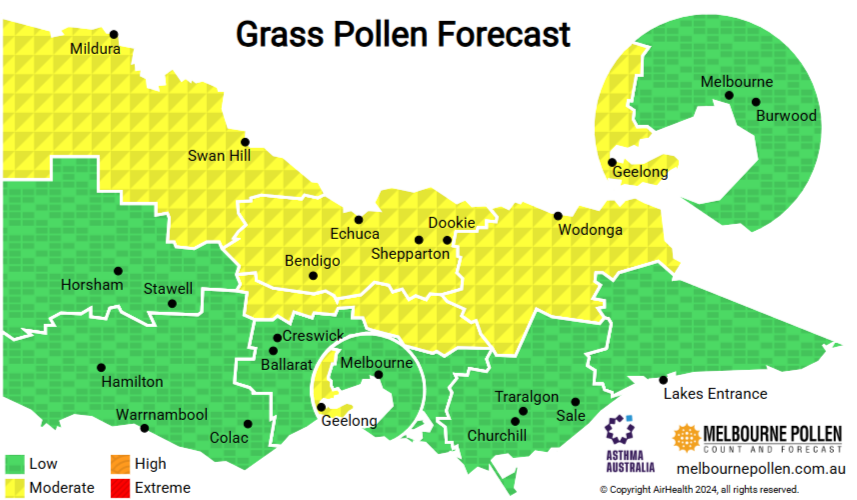
It’s an almost defiantly unglamorous origin story for what has become a crucial early-warning system now operating at eight sites across Victoria.8 This manual, slide-based count is now supplemented by a network of automated pollen counters that continuously verify and refine the forecasting model in real time.9 Since 2016, the pollen-counting service has joined hands with the Victorian Department of Health and the Australian Bureau of Meteorology (BoM) to enable monitoring in often-overlooked areas.8 This forecast aids in determining regions of high risk during a thunderstorm asthma event.
A threat that does not discriminate
Perhaps the most unsettling thing about the night of 21 November 2016 is who it caught out.
Every one of the 10 people who died had a history of asthma.3, 10 But among the thousands who ended up in hospital, a great many had never been diagnosed with asthma before—some had no idea there was anything wrong with their lungs until the moment there was.3, 10 Follow-up testing on patients who presented during the event found that nearly two-thirds showed no prior diagnosis, despite clear clinical evidence of asthma once properly assessed.11 But the strongest common thread was hay fever, or allergic rhinitis, a condition of the nasal passages, not the lungs.
Later studies found that up to 87% of people who sought treatment that night had a history of seasonal allergic rhinitis.3,10 For many, thunderstorm asthma was their first ever asthma attack, and it occurred without warning in the middle of a statewide emergency.
Another finding highlighted that people of a South or East Asian ethnicity were significantly more likely to develop symptoms than those from other backgrounds, even after researchers accounted for other risk factors.3,12 The leading explanation is that many immigrants develop a particular sensitivity to Australian grass pollens to which they were never exposed as children.12
Thunderstorm asthma is clearly a multifactorial problem. It is not purely a weather event, or a medical one, or simply a matter of who has ‘bad’ asthma. It’s an alignment of plant biology, atmospheric physics, and individual allergy history—threads from separate fields, sewn together into a bodily condition.
A season that ebbs and flows
A recent analysis of the three decades of Melbourne pollen data shows the influence of climate change. The city’s grass pollen season now measurably begins earlier and runs longer than it did in 1991—its onset creeping forward by roughly a third of a day each year, and its length stretching by nearly half a day longer every year.13 Multiply that by 30 years, and you get a springtime which, in all its blossoming beauty, takes more time to loosen its grip.
The same research found that year-to-year pollen levels swing substantially depending on rainfall and drought conditions, which are themselves shaped by El Niño-Southern Oscillation events. Spring rainfall is strongly linked to heavier grass pollen the following season, while prolonged drought years tend to suppress the pollen load.13 Because the State’s daily risk forecast depends on anticipating pollen levels as accurately as possible, this makes the forecasting harder in years when rainfall patterns break from the norm.
A 2025 clinical review went further still, concluding that climate change is likely already lengthening and intensifying pollen seasons while also increasing the odds of extreme, erratic weather that may heighten pollen levels into allergenic concentrations.14
A second area of current scientific interest is much closer to home, says Sudharsun (Sun) Venkatesan, a postdoctoral researcher at Deakin University. His work focuses on alternative mechanisms for thunderstorm asthma, notably the role of lightning and of tree pollen in inducing allergies.15 He pointed out that almost all public messaging about pollen risk is based on forecasts for regional and rural grasses, while hardly anyone stops to consider what is actually growing in their backyards.15
As water restrictions and hotter, drier summers push Victorian gardens toward drought-tolerant ornamental grasses, close-range, backyard exposure becomes a blind spot. And active allergies may not be restricted to grasses. “Establishing non-native plants like pines can lead to autumn allergies as well. This area, however, requires more research,” Sun says.15 Adapting to climate change, it turns out, may not only be a matter of tracking enormous weather systems, but also noticing what you planted in the back garden last spring.
Living with the system we built
The 2016 catastrophe produced a massive response: a $15.6 million ETSA forecasting system that combines BoM storm data with pollen counts and runs every year from 1 October to 31 December.1 It issues a daily colour-coded forecast of risk—green, orange, red—through the VicEmergency app, green being low risk and red, extreme risk.9 The forecast is careful to point out what it is not: it is neither a guarantee nor a substitute for managing your own asthma or hay fever in the first place.9
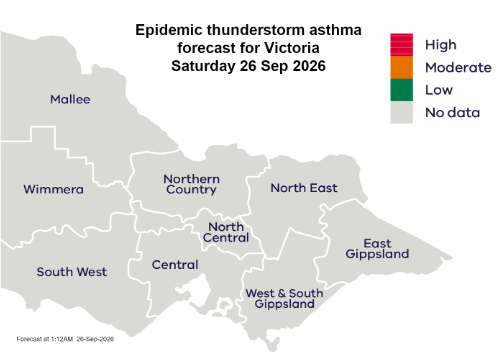
Current advice for Victorians is to treat the entire pollen season, not just the red days, as a period of potential risk; avoid storms and the wind gusts that precede them; and pay attention to the VicEmergency and/or AirHealth apps.8, 9 People with current or past asthma, or a history of springtime hay fever, should consult their physicians for a preventive or treatment plan at the start of the season. And keeping a reliever on hand is recommended.9
Hope for a better prepared future
After many decades of pollen counts, a decade of storm modelling, and a hard-won understanding of who is most at risk, Victoria's current thunderstorm asthma management strategies are now far better prepared.
Climate change, however, brings new risks. With the pollen season regularly overstaying its welcome and storms becoming less predictable, the state’s health systems need to stay ahead and alert. None of this makes the current systems obsolete—if anything, it’s why the counting, modelling, and the push towards faster, more efficient detection matters more with each passing year.
Our system built on the past has to keep re-learning the present. And for those living under that system, checking the pollen count should become a habit treated with the same seriousness we give the UV and fire risk ratings in the summer.
References
- Chastin, K. (2018) Australian state forecasts deadly thunderstorm asthma. Science 359 (6374): 380. https://www.science.org/doi/10.1126/science.359.6374.380
- ABC News (2018). Melbourne thunderstorm asthma inquest: Victims' survival chances greater if symptoms noticed. https://www.abc.net.au/news/2018-06-25/thunderstorm-asthma-inquest-victims-cardiac-arrest/9907120
- Thien, F. et al. (2018) The Melbourne epidemic thunderstorm asthma event 2016: an investigation of environmental triggers, effect on health services, and patient risk factors. The Lancet Planetary Health 2 (6): e255-e263 https://doi.org/10.1016/S2542-5196(18)30120-7
- Emmerson, K. M. et al. (2021) Atmospheric modelling of grass pollen rupturing mechanisms for thunderstorm asthma prediction. PLOS ONE 16 (4): e0249488. https://pmc.ncbi.nlm.nih.gov/articles/PMC8046208/
- Bannister, T. et al. (2021) A pilot forecasting system for epidemic thunderstorm asthma in southeastern Australia. Bulletin of the American Meteorological Society 102 (2): E399–E420. https://doi.org/10.1175/BAMS-D-19-0140.1
- Price, D. et al. (2023). The perfect storm: Temporal analysis of air during the world's most deadly epidemic thunderstorm asthma (ETSA) event in Melbourne. Therapeutic Advances in Respiratory Disease 17. https://doi.org/10.1177/17534666231186726
- Newbigin, E. et al. (2015) The sticky business of pollen counting. Pursuit, University of Melbourne. https://pursuit.unimelb.edu.au/articles/the-sticky-business-of-pollen-counting
- Melbourne Pollen. (2026). About us. School of BioSciences, University of Melbourne. https://www.melbournepollen.com.au/who-are-we/about-us/
- Department of Health, Victoria (2026) Epidemic thunderstorm asthma risk forecast. https://www.health.vic.gov.au/environmental-health/epidemic-thunderstorm-asthma-risk-forecast
- Thien, F. (2022) Epidemic thunderstorm asthma. The Lancet Respiratory Medicine 10 (4): 325-326. https://www.thelancet.com/journals/lanres/article/PIIS2213-2600(22)00083-2/fulltext
- Douglass, J. A., & Tham, R. (2024) We now know a lot more about thunderstorm asthma. Pursuit, University of Melbourne. https://pursuit.unimelb.edu.au/articles/we-now-know-a-lot-more-about-thunderstorm-asthma
- Harun, N. S. et al. (2021) 2016 Thunderstorm-asthma epidemic in Melbourne, Australia: an analysis of patient characteristics associated with hospitalization. Canadian Journal of Respiratory, Critical Care, and Sleep Medicine 5 (5): 276–282. https://doi.org/10.1080/24745332.2020.1727301
- Dhankhar, A et al.(2025) Influence of ENSO, droughts, and temperature rise on pollen and pollen seasons in Australia. Science of The Total Environment 975: 179326. https://doi.org/10.1016/j.scitotenv.2025.179326
- Thien, F. et al. (2025) Thunderstorm asthma: Current perspectives and emerging trends. The Journal of Allergy and Clinical Immunology In Practice 13 (6): 1273–1280. https://doi.org/10.1016/j.jaip.2025.04.001
- Venkatesan, S. (2026) Personal communication, Deakin University.
Other articles of interest





Discover how you can join the society
Join The Royal Society of Victoria. From expert panels to unique events, we're your go-to for scientific engagement. Let's create something amazing.