Ghostnets: how a great engineering material has become an oceanic problem
Science Victoria Edition

GhostNets Australia Program Manager, OceanEarth Foundation

Plastic has become synonymous with pollution. The images we see of floating bottles, overflowing landfill and beaches strewn with plastic rubbish display one of the defining environmental issues of our time.
But they also mask an uncomfortable truth: plastic is no engineering failure. Quite the opposite. It is one of the most remarkable materials humankind has ever created.
Articles made from plastic are often described as “disposable”, yet very little about them is. Every piece of plastic represents millions of years of stored solar energy, extracted from limited resources deep within the earth, and then refined, manufactured, and transported around the globe to be engineered into products designed to withstand some of the harshest environments imaginable. Yet we ascribe almost no value to plastic the moment we finish using it.
Plastics are deliberately engineered to be lightweight, incredibly strong, resistant to saltwater, corrosion and decay, and capable of lasting for decades. Those properties have transformed industries such as fishing, where modern synthetic ropes and nets have dramatically improved safety, efficiency and productivity.
The issue is that when plastic becomes waste - it continues to do exactly what it was designed for.
Nowhere is this more evident than in the ocean.
When fishing gear becomes ghost gear
Ghost gear refers to those fishing nets, ropes, traps and lines that have been lost, damaged, abandoned or discarded in the marine environment. Once there, the nets keep catching fish, the lines entangle wildlife and the ropes snag coral reefs. Trapped animals attract predators, increasing the risk of further entanglement and creating a feedback loop. So the gear keeps on behaving as the designers intended, but without human supervision.
It is tempting to imagine that ghost gear exists simply because people acted irresponsibly. But the reality is often far more complex. For many fishing communities, the choice is rarely between protecting the environment or polluting it, more likely it is between fishers risking their safety to recover damaged gear or earning enough to support their families.
Estimates suggest around 2% of fishing gear is lost globally each year [1],but that seemingly small percentage represents an enormous quantity of material. Of the hundreds of millions of kilometres of fishing nets and lines deployed annually, it's conservatively estimated that up to a million tonnes is lost. [2]
Consequences of good design
And once lost, this ghost gear begins to impact marine ecosystems in many different ways. These impacts are not accidental. They occur because of the very properties that made plastic fishing gear such a remarkable innovation. Its strength allows nets to keep catching animals long after they have been lost at sea. Its resistance to saltwater and decay enables those nets to persist for years, while the flexibility of plastic allows ghost gear to drift with currents, snag on reefs and entangle marine life.
Perhaps entanglement is the most visible impact. Whales, turtles, dugongs, dolphins, sharks and rays all become caught in drifting ropes and nets, but these are only the larger, more emotive victims. Ghost gear also entangles fish, crabs and other commercially important species. And every fish caught, through this ghost fishing, is one less available to support ecosystems, fisheries and coastal communities.
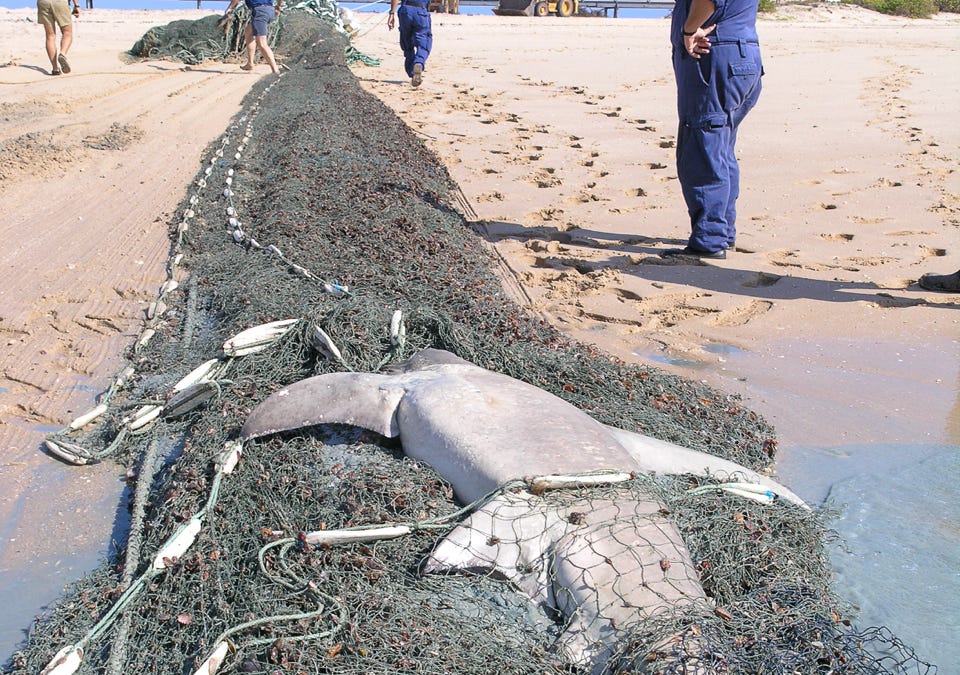
This creates an unfortunate feedback. Reduced fish stocks place greater pressure on fishers to spend longer at sea, travel further offshore, and work under more challenging conditions, which increases both operational costs and the risk of additional gear loss. For fishing communities, environmental and social challenges become intertwined, reinforcing each other in ways that are rarely visible if we view ghost gear simply as a problem, rather than a symptom.
Ghost gear also damages the habitats upon which healthy fisheries depend. Nets draped across coral reefs can break up fragile colonies, and ropes can abrade reef structures as they move with the tides and currents. In seagrass meadows and other sensitive habitats, abandoned gear can smother vegetation. That, in turn, alters local ecosystems and reduces the habitat available for juvenile fish and other marine life.
But entanglement is only the beginning.
Microplastics: the final chapter
Sunlight, waves and abrasion slowly weaken the plastic, causing larger pieces to fragment into increasingly smaller particles. These plastic remnants, known as secondary microplastics, are now recognised as an important source of marine pollution. They are consumed by plankton, shellfish and fish alike.
In this way, plastic enters the food web. And growing evidence suggests plastics may also bring chemical additives and environmental contaminants with them, raising questions about the implications for broader ecosystem and human health.
Exactly how much secondary microplastic is generated in the marine environment from abandoned fishing gear is difficult to quantify. Ocean conditions are highly variable, and distinguishing the exact source of micro and nano particles is difficult. But field experience provides all the understanding needed to recognise the potential impact.
Working alongside the Dhimurru Rangers in north-east Arnhem Land to recover ghost nets that have washed ashore from across the Arafura and Timor Seas, it quickly becomes apparent just how persistent these materials are.
Some nets weigh tens of tonnes and have been buried beneath the sand for months or years. As they are hauled free and cut into manageable sections with hot knives, tiny blue and white fragments begin to fall away. By the end of the day your hands are coated in a fine plastic dust, the sand beneath your feet is speckled with tiny particles of the same colours as the ropes and netting you’ve spent hours handling. And it’s all dragged home on your clothes.
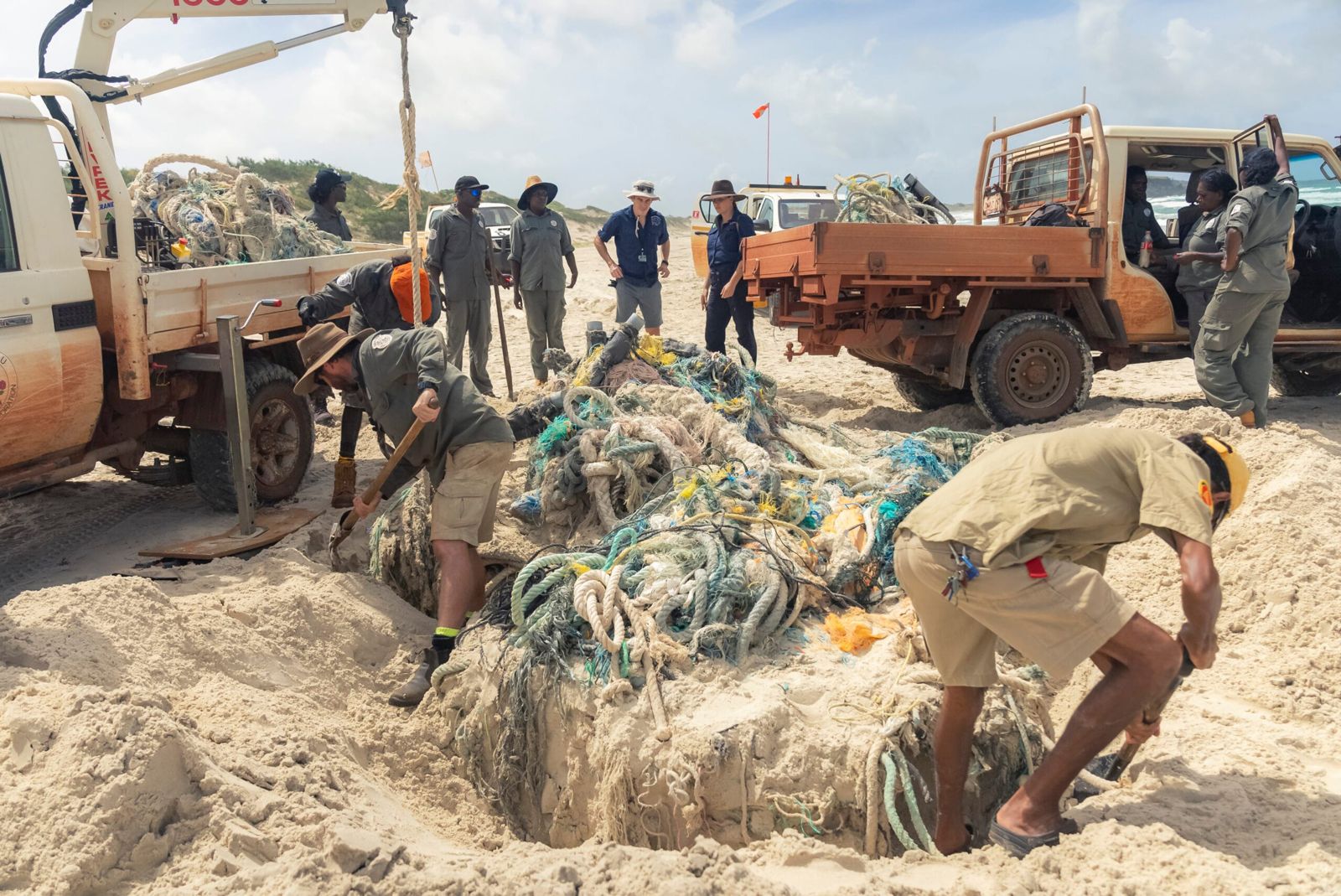
Estimating how much microplastic is generated is scientifically challenging, but standing on a northern Australian beach leaves little doubt of the potential for a single weathered ghost net to become a substantial source of secondary microplastics.
Conservation has long been guided by the precautionary principle: where potential consequences are serious and difficult to reverse, uncertainty should not become an excuse for inaction. Waiting until every question about microplastics has been answered risks overlooking the many opportunities we already have to prevent generating them in the first place.
Importantly, secondary microplastics are rarely the beginning of the problem - to which ghost gear attests. Typically, they represent the final chapter of a much longer system failure. Before a fishing net fragments into microscopic fibres, it has already been manufactured, transported, purchased, used, lost and left unrecovered, often for years. So we could intervene in this process long before the plastic reaches this stage.
Rethinking value
Perhaps the greatest irony is that most fishing gear is made from valuable polymers such as nylon and high-density polyethylene (HDPE). If recovered early enough, these materials can be recycled into new products. Their durability, strength and chemical stability also make them excellent candidates for reuse.
But once ghost gear has spent years submerged in seawater, exposed to ultraviolet radiation, colonised by marine organisms and contaminated with sand, salt and other debris, recycling becomes technically more difficult and economically less attractive. So material that once held considerable value becomes harder to recover over time.
Perhaps our plastic problem is really a value problem. We have become remarkably good at overlooking the energy, engineering and resources embedded in these materials once we have finished using them.
Ghost gear reminds us that environmental problems rarely begin where we first notice them. The net drifting silently through the ocean is not the start of the story. It is the visible consequence of countless decisions about product design, waste management, economics and infrastructure that occurred years earlier. Ghost gear actually requires us to think less about cleaning up pollution and more about preventing it in the first place.
Find out more about the Ocean Foundation and its GhostNet program:
oceanearthfoundation.org.au/ghostnets-australia
References
[1] Richardson, K. et al. (2022), Global estimates of fishing gear lost to the ocean each year. Science Advances, 8 (41): eabq0135. doi:10.1126/sciadv.abq0135
[2] Jambeck, J. R. et al. (2015), Plastic waste inputs from land into the ocean. Science 347 (6223): 768-771. doi:10.1126/science.1260352
Other articles of interest





Discover how you can join the society
Join The Royal Society of Victoria. From expert panels to unique events, we're your go-to for scientific engagement. Let's create something amazing.